
Remembering Jim “Boomer” Gordon
By Mick Kern
Iconoclast – a person who attacks settled beliefs or institutions
It’s a start, but that definition only partly describes the complex construct that was, and always will be, Jim “Boomer” Gordon.
A sports fanatic with a steel-trap mind, Boomer emerged from the rough-and-tumble steel mills of Hamilton, Ontario, and in quick order became one of the more iconic voices in sports radio. And in typical Boomer fashion, he threw away the rule book as he forged his unique path to the microphone and into the lives of countless hockey fans. In an age where expensive sports broadcasting schools spit out talented yet largely homogeneous talent ready-made for the airwaves, Boomer was an original.
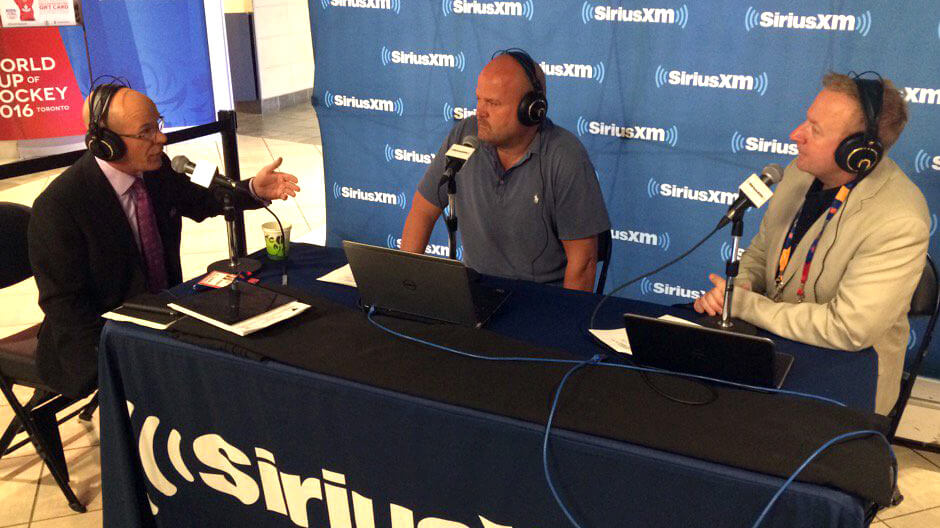
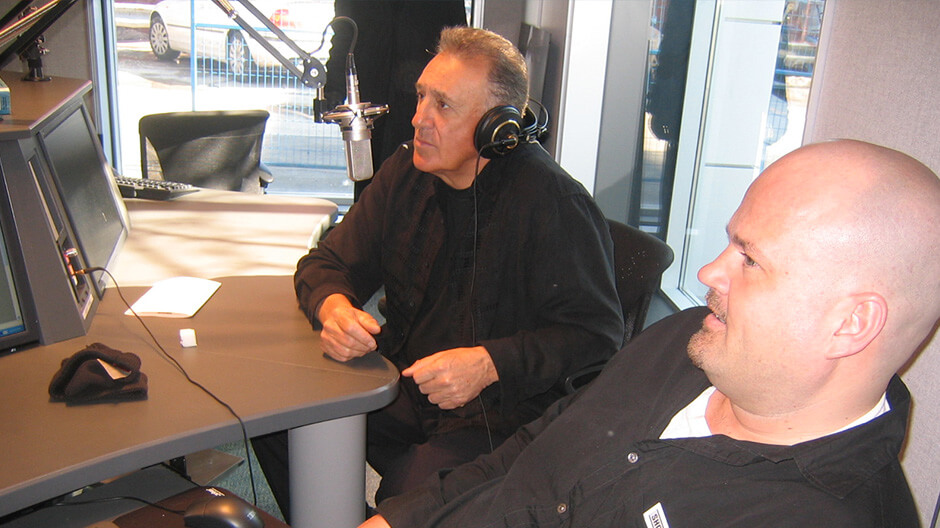

Looking back over twenty years, one has to remember that Boomer was very much a broadcasting long shot. But Joe Thistel always liked long shots.
It’s important to take a moment to set the context properly. We go back to the summer of 2005.
Late August that year, I received a call from Joe, informing me that the powers that be had secured a broadcasting license to operate satellite radio in Canada. It would be partnered with XM in the States. Oh, and the channel Thistel was in charge of would be all hockey. Would I be interested in joining?
Would I? Heck, I’d been dreaming about such a job long before it even existed. My story was no different than anybody else who was on board as of Day One. Scott Laughlin, Cam Stewart, Mike Ross, Shawn Lavigne, Sam Cosentino, Eric Gage, Jamie Shalley, and Peter Berce all shared similar stories. Each one of us slowly worked our way up the highly competitive Canadian broadcasting beanstalk, both in radio and television. Thistel assembled a crew that he admits, 20 years later, was better than even he initially envisioned.
By Hallowe’en of 2005, the entire crew was in place, and we feverishly worked around-the-clock to launch Home Ice.
So, when Joe had us congregate for the first full staff meeting in our temporary headquarters down near the Rogers Centre here in Toronto, there were more than a few eyebrows raised when, sitting around the table with all the guys, was a newcomer. An outsider.
Big hulking dude. Bald. Intimidating, though he didn’t initially say very much. Thistel launched into his introductory spiel, and eventually the talk turned to the team he had cobbled together. After the usual jokes and wisecracks that helped ease the tension we were all feeling, Thistel turned to the big hulking dude.
“Guys, this is Jim Gordon. He’s going to be a part of our staff. Knows his sports like nobody’s business, and we’ll find a role for him. Lots to do, boys, lots to do.”
On the way out, somebody whispered to me that Boomer was the brother-in-law of one of the executives at XM, hence why he was there. That connection undoubtedly opened the door, but once inside, he made the most of the opportunity.
As we scurried about during those frantic first weeks, there was scant time to train a green rookie on the innumerable nuances of sports talk radio. Thistel came to Shawn and I and asked what should we do with Jim Gordon. Joe wanted to have him help out on the “Live From Wayne Gretzky’s” radio show that we had been broadcasting for the past couple of years every Saturday afternoon from the famous restaurant.
Made sense. We had been staging our XM Home Ice on-air dry runs from the restaurant, tucked into a corner on the main floor, close to the bar. Jim had been helping with the technical setup. He was a fast learner, and slowly he began to feel more comfortable being around the rather tight group of guys.
One of those misty mornings, while back in the control booth, checking the microphones, and making sure our connection to Washington, D.C. was up and running, I overheard the following conversation over the monitors…
Scott Laughlin: “You know who you look like?”
Jim Gordon: “I get this a lot.”
Scott Laughlin: “Boomer Wells.”
Cam Stewart: “The pitcher? Yeah, you do.”
Jim Gordon: “Okay.”
Cam Stewart: “Boomer…yeah, that works. We’ll call you Boomer.”
Jim Gordon: “Beats being called Caillou, which is what they called me at the steel mill.”
And Boomer it was. From that day forward, I don’t recall anyone calling him Jim anymore. While Jim Gordon as a name would have worked on the air, having a short, catchy moniker such as Boomer was tailor-made for sports talk radio.
Mind you, Boomer wasn’t actually on the air right away. He assisted me with the “Live From Wayne Gretzky’s” technical setup to the point that he could do it blindfolded. But he yearned to do more, and told me so one lazy Saturday afternoon, complaining that he wasn’t learning enough about how to put together a radio show.
That would come, I assured him; right now, we’re just trying to get to air.
November 22nd, 2005, that happened. We went to air. And a whole new world opened up for us, and the hockey listener, particularly in many parts of the United States. A channel dedicated to the National Hockey League. We didn’t have the rights to the NHL shield at that point, but it would follow in short order.
Like many of us, Boomer performed a myriad of tasks during those early days. Technical setup, researcher, and guest booker/producer. I can still clearly recall the first guest who got back to him.
With the sound of wonderment in his voice, he looked up from his desk phone, and informed Mike Ross and I that he had earlier left a voice message for Jeremy Roenick, and was shocked that the veteran forward had actually returned his call.
From that point forward, Boomer was hooked, and Joe Thistel immediately tasked him with learning how to become a radio show producer.
Surviving the usual start-up hiccups, Home Ice slowly found its feet and its audience. Mike Ross produced the afternoon show with the legendary Jim Tatti and Gary Green (I was the technical operator). Rossy was laying the groundwork for his own on-air opportunity when he had the foresight to include a brief on-air segment for himself every show, highlighting the NHL Quote-of-the-Day.
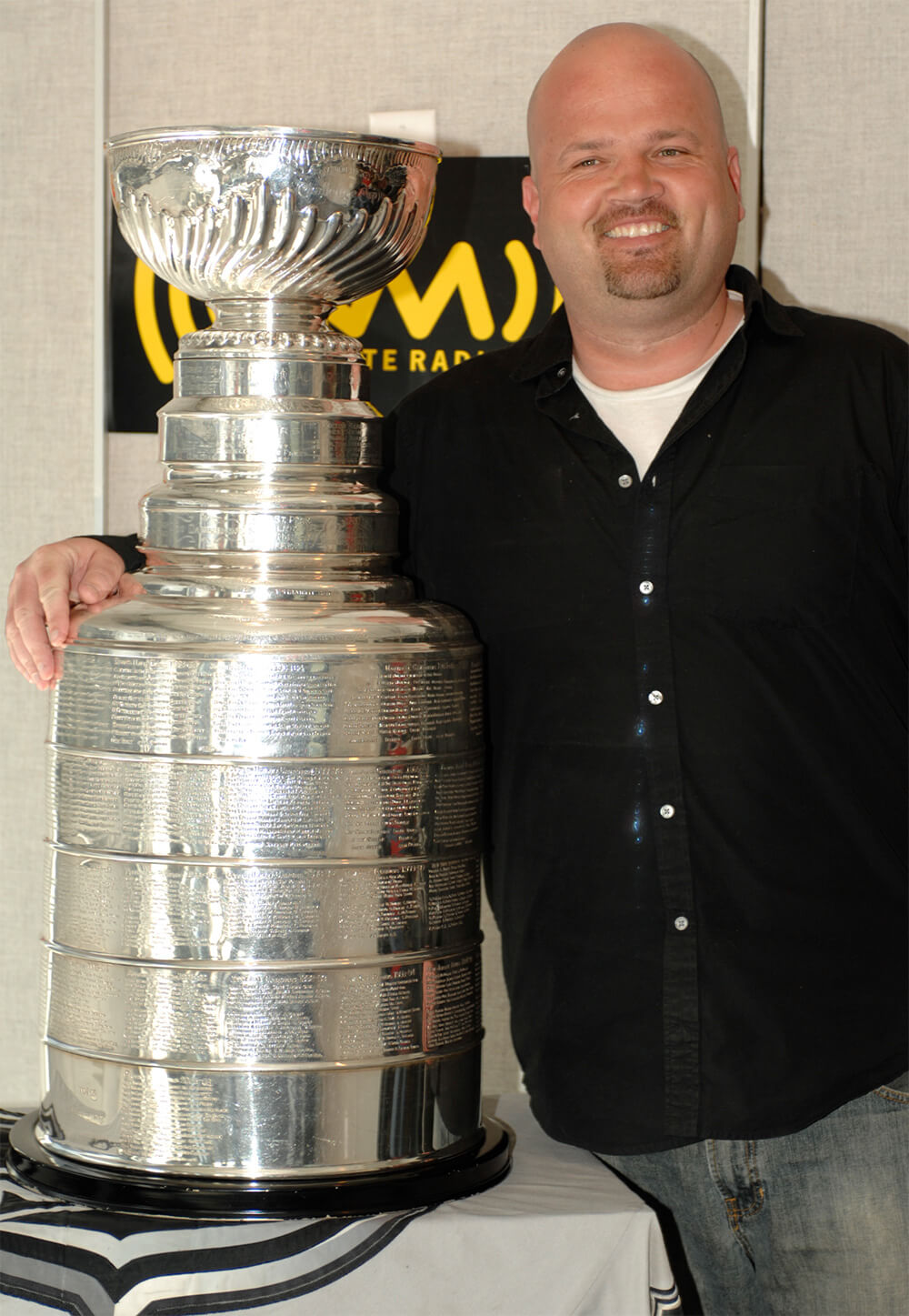
Boomer came up to me one afternoon and asked if I also wanted to be on-air. I said sure, if and when that opportunity presented itself. How about you, I asked.
Like the rest of us, Boomer had watched endless sports on TV, listened to sports radio, and no doubt said to himself, “I can do that.” Everybody believes they can. It’s a different thing once that red light goes on, and every word you say is examined, and every word you utter could be your last on-air.
I knew this, Rossy knew this, Scotty knew this. Boomer instinctively knew this, but he wasn’t hampered by orthodox Radio 101 thinking. Being outside of the establishment has its benefits.
Boomer was a massive sports fan with well-informed opinions, and at some point, he craved a public platform. Yet unlike 50 million other like-minded men and women across the United States and Canada, he was literally standing a few feet away from actually having that opportunity.
So close your eyes right now, and recall the deep, resonant bass tones that emanated from your speakers whenever Boomer spoke. He said yes. One day, he’d like to get on-air.
That day arrived sooner than later. Late one dark winter’s afternoon, while doing some commercial production work down in one of the editing suites at our Avenue Road and Davenport studios, there came a knock at my door.
Joe Thistel popped his head in and told me to follow him upstairs. He then said the same thing to Boomer, who had been busy, even then, meticulously handwriting his hockey notes onto a pad of paper.
“Get ready for the rest of your life”, I clearly recall Joe saying to both of us as we marched upstairs and into the spacious on-air studio.
We joined host Todd Lewis for a 10-minute segment where we kicked around a couple of NHL topics. One topic was whether or not Colin Campbell would be the next GM of the Toronto Maple Leafs.
It was an inauspicious debut for both of us. Though I had plenty of radio experience, I was rusty. For Boomer, this was uncharted territory. His familiar voice of authority mixed with more than a touch of humorous scorn was softer that afternoon.
But his content was good from the start, and he slowly grew into the role. And to be frank, it was a financially challenging time for the fledgling XM service up in the Great White North back then, thus we didn’t have the budget to import a lot of big names.
That provided opportunities, which is how this business has always worked.
So Joe Thistel did what any smart manager would do. He listened. He listened while the staff talked, laughed, and argued hockey out “on the floor.” He quickly identified who knew their stuff (actually, everyone there), and who could possibly make the leap to on-air.
But making occasional appearances is one thing; could these guys cut the on-air mustard on a daily basis?
To find that out, Joe paired Boomer with Mike Ross during the summer. Even then, Rossy was the smooth, professional radio host. He put the ball on the tee, and Boomer hit it out of the park. And Rossy could hit more than a few home runs himself. They were a good pairing; two relatively young guys, one a radio vet, and the other a lifelong fan. Whenever Boomer struggled early on, Rossy had his back, and by the end of the summer, both had improved their broadcasting skill sets.
Joe Thistel tried Boomer with a number of on-air hosts, but nothing really stuck. Already, Boomer’s distinct style had emerged, and it was clear that he was destined to be a One Chair. Radio jargon meaning his force of personality dictated that he would be much more effective being the guy who drove the bus, as opposed to being the sidekick. He was stubborn. In a good way.
But who to team him up with?
As time passed, Joe Thistel would jump on-air with Boomer, and very quickly it became apparent they had developed a unique chemistry.
(Boomer and Jake Hahn would also deliver an effective one-two punch during The Point for the better part of the last decade.)
Boomer and The Boss. Joe would handle the ins and outs for each segment, and Boomer would pontificate. And often Joe would verbally roll his eyes and challenge Boomer. And Boomer wouldn’t back down an inch. It made for good radio. Okay, sometimes they spent twenty minutes talking about Tiger Woods, but they always got back to the NHL.
Displaying his penchant for thinking outside the traditional hockey box, Boomer often elicited replies of “you’re crazy” from Joe. Boomer wasn’t afraid to step on toes, nor to slay sacred hockey cows. As he once said to me, “I’m not looking to get hired by the NHL.”
That damn the torpedoes approach is why listeners took to him right away. He was, on the surface, the Everyman, though he was much smarter than that. His sharp intellect wasn’t limited to sports, though Boomer could converse about any sport, as illustrated by the many times over the years that the two of us lamented the sorry state of our beloved Montreal Expos.
Boomer grew up a fan of the New York Islanders, and one day, he slowly turned around in his chair and looked at me.
“I still can’t believe I get to talk with Potvin and The Boss”. (Denis Potvin and Mike Bossy were early insiders on the channel).
By the way, that’s how things worked. Boomer talked to you. You didn’t talk to Boomer.
He wasn’t a snob, nor someone who thought he was better than you. It’s just that when Jim Gordon would immerse himself deep into an article or his research, he loathed being interrupted. He’d be begrudgingly polite about it, but he made no apologies for being engaged elsewhere. The couple of times I crossed that line, Boomer would almost always get back to me later to pick up on the topic.
He was locked in and wanted to make sure he had all the bases covered before going on-air. We all do that. Scott Laughlin is one of the most prepared hosts I’ve ever worked with. Same with Steve Kouleas. Being primarily a phone-in show, my focus is slightly different, but we all prepare. We have to. Boomer didn’t prepare more; he just prepared differently.
Off-air, the staff of the channel would try not to talk just hockey when we were in the building, just to keep things fresh. One needs a break (Boomer once told me he tended not to watch hockey on Friday nights just to clear his head). Baseball was a big talking point around the office, and I ran a staff pool for years. Boomer and Thistel would have epic discussions about golf.
Music was always a topic for debate. Boomer was a fan of The Tragically Hip, even travelling to the States on a number of occasions to see the quintessential Canadian band perform in concert. We both shared an appreciation for Nirvana and Amy Winehouse.
For about a two-year period, circa 2018, Boomer became obsessed with stumping me on Beatles’ trivia.
He knew I was a lifelong devoted fan of the Fab Four, so one day he declared that he was going to find a trivia question I couldn’t answer.
At first, Boomer mined The Beatles Channel on SiriusXM for nuggets, a channel chock full of stories and trivia. But honestly, the Beatles’ minutiae offered up there are usually at an entry-level of knowledge. I easily batted away his first attempts.
So Boomer upped the stakes and began to do his own research. The question became more nuanced. I also batted away those volleys.
Finally, one morning, he thought he had me.
“Mick, I have a Beatles’ question you can’t answer.”
“Okay.”
(After a dramatic pause)
“Tell me what the song…”
For some reason, I had a feeling he was going to ask me about the McCartney composition “Got To Get You Into My Life.” So I playfully pre-empted him and answered before he had finished delivering the question. Pure shot in the dark on my part.
”Got To Get You Into My Life” is about Paul’s affection for marijuana, and was released on Revolver in August of 1966, but was a surprise hit in 1976, off the Rock and Roll compilation album.”
Boomer just looked at me, shook his head, turned around, and we never spoke of the subject again.
For someone I worked beside for twenty years, Boomer was a difficult guy to get to know. Boomer rarely socialized with anybody from the channel outside of work hours, and we never really talked about anything but sports and music. Occasionally, he’d let down his guard, but less so as the years piled up. He’d ask about my son (they share the same birthday), especially when Alex was playing Double-A hockey in the GHTL. Boomer loved stories about crazy hockey parents.
When he found out my university degree was in film studies, movies were on the menu. We agreed on a lot of the classics, but he couldn’t fathom why I enjoyed Pulp Fiction, to the point that he watched it on three different occasions, each time coming in that Monday morning to again pepper me with questions about what I saw in it that he didn’t. Boomer wanted to know things. He wanted to know how and why. Five Burning Questions. And he didn’t want the official answer, the company spin. His curiosity was unquenchable.
As his long-time co-host Jake Hahn puts it, “You never knew what Boom would bring up during a show, and that’s part of what made him so unique. He took pride in bringing thoughts and talking about things other shows weren’t. As a co-host, it kept you on your toes and made for honest, in-the-moment reactions.”
Off-air, Boomer was not the sort for idle small talk, which I appreciated. He rarely asked how you were doing, unless he was genuinely interested. For instance, when I returned to work after missing almost four weeks in early 2012 due to a terrible case of pneumonia, Boomer wanted to know what I went through, what it felt like, and how long it took to feel normal again.
Don’t get me wrong, Boomer wasn’t a grump, off ruminating somewhere on his own island. Okay, he sometimes could be. But so could most of us at the channel. In an occupation where you have to be on every time that red light goes on, where you have to dance regardless of how you’re feeling that day, it’s understandable why so many electronic media types are very different away from the mic.
The closest I got to seeing another side of the man was in January 2011.
Due to his deep NFL knowledge, he had entered a football pool with XM Canada management, including Joe Thistel. And they won. The first prize? A free trip to an NFL city of your choice for a playoff game.
It was brutally cold that winter, and Boomer had his sights set on a warm-weather city. Alas, the scheduling didn’t work out, so it was between Pittsburgh and Chicago.
One afternoon, Boomer sauntered over to my production booth and asked which city I preferred. I said I had never been to Pittsburgh, and he replied, “Good,” because that was basically his choice.
Turns out I was going in place of Paul Williams, part of upper management at the company. Paul kindly gifted me the trip for the many NFL radio duties I had performed for him over the past decade.
We all bundled onto a small prop plane on a cold Saturday morning and flew to frozen Pittsburgh. We took a tour of the new arena, watched the Penguins play the Hurricanes, finally saw the Igloo in all its glory, enjoyed awesome sandwiches, and I walked around the perimeter of PNC Park.
Boomer and I ended up sharing a hotel room, and immediately he discovered that ESPN had five channels available on the TV. He asked if I minded; knock yourself out, I replied. Boomer had discovered Nirvana.
The plan was for all of us to spend a pleasant Saturday night (after the Penguins’ game) at a local bar, downing more than a few frosty mugs of ale while we argued sports and movies long into the night.
Well, Thistel and I ended up doing so, along with a number of XM Home Ice fans who showed up.
Boomer? ESPN was too enticing to leave.
“Tell Joe sorry, but I’m not going to be making it tonight. I’ll see him at the game tomorrow.”
Which is what happened. 2011 AFC Championship Game. Jets at Steelers. Pittsburgh scored all its points in the first half. New York attempted a second-half comeback. After having survived bitterly cold winters in Edmonton and Ottawa, I’m not sure I’ve ever been colder than on that long January afternoon in the great Pennsylvanian outdoors.
Boomer?
Probably didn’t notice the cold. He was like a kid in a candy store, especially when the Steelers snuffed out a late 4th quarter drive by the Jets, and took the game 24-19. “We’re going to the Super Bowl.” He repeated that at least three times, as he clapped his massive hands together. The radiant smile on his face was something I had never seen before.
On the boat ride back to the hotel (yes…really), Boomer joined us for a frosty ale, the grin frozen on his face not due to the frigid weather, but because he was where he should have been that day. Watching his beloved team win a big game.
Just over a week before Boomer passed away, I called him. He sounded pleasantly surprised. Probably because it was only the second time we’d ever talked on the phone.
There had been no reason before.
Boomer sounded strong, and when I asked how he was doing, he replied, “Great.”
Yeah, that wasn’t the case, and he chuckled as he admitted so.
We spoke for about twenty minutes, and while most of it will remain private, the two of us reminisced about some of the laughs we had enjoyed over the past two decades, including that trip to Pittsburgh.
As we wrapped up the conversation, he asked, “When do most of the important events in one’s life occur…before 55 or after 55?”
Sure, he said, he’d have liked to have lived until 70, but that wasn’t in the cards. He had been spending the past few days going over all the things he experienced during those 55 years. The Toronto Raptors’ run to the NBA Championship in 2019 was one such highlight, as Boomer attended all the games down in the great press row seats. You could hear that radiant smile again as he recounted to me that magical spring that now seemed so long ago.
So how does one end a conversation with someone you know, yet you don’t really know? A conversation you know will be the last one you ever share? It seemed apropos to ask him about the Steelers, as Jim “Boomer” Gordon is, to me, the ultimate Pittsburgh Steelers fan.
When I asked his opinion about the recent head coaching change, he paused, then laughed.
“Funny you should ask that. Here I should be thinking about family, and friends, and my life, but yeah, I’m also thinking about the Steelers. They were a proud franchise that has now lost their way. It pisses me off.” And then he laughed again.
There was a brief silence, and then Boomer thanked me for calling.
“Take care of yourself.”